




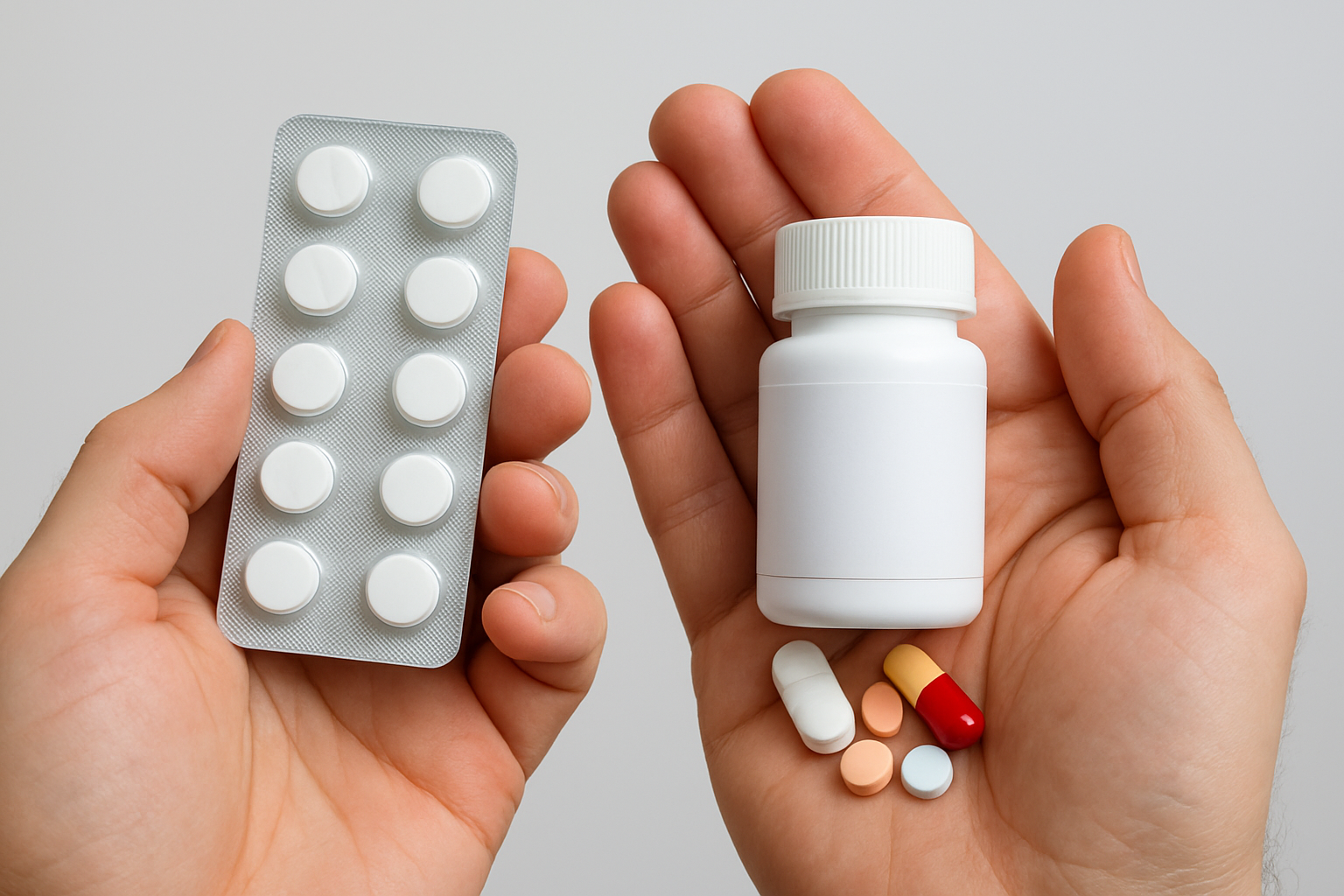
You go to a pharmacy with a prescription. The pharmacist says the prescribed brand costs 12 taka a tablet, but there is another one with the same ingredient for 4 taka. Is the cheaper one worse? Is it fake? Is the expensive one just better packaging?
This confusion costs Bangladeshi families real money, and it occasionally costs them their treatment when the expensive option is skipped entirely. Here is how the system actually works.
Three Names for the Same Thing
Every medicine has up to three names, and mixing them up is where most of the confusion starts.
The chemical name describes the molecular structure. Nobody uses it outside a laboratory.
The generic name, also called the international non-proprietary name, is the official name of the active ingredient. Paracetamol. Metformin. Omeprazole. Amoxicillin. This name is the same everywhere in the world and belongs to no company.
The brand name is what a company calls its version. One generic molecule can have dozens of brand names in Bangladesh — the same paracetamol sold under many different labels by different manufacturers.
So when someone says “generic medicine,” they usually mean a product sold under, or closely associated with, the generic name rather than a heavily marketed brand. When they say “branded,” they usually mean a marketed brand name product.
The Distinction That Actually Matters
Here is the part most explanations get wrong for the Bangladeshi context.
In the global pharmaceutical industry, “branded” usually means the originator product — the one developed by the company that discovered the molecule, protected by patent, sold at a premium during exclusivity. “Generic” means a copy made after the patent expired.
In Bangladesh, that framing rarely applies. Because of the LDC waiver under the WTO TRIPS agreement, local manufacturers have been able to produce patented molecules without licences. As a result, almost everything on a Bangladeshi pharmacy shelf is technically a generic, regardless of how it is branded and priced. What you are usually choosing between is not originator versus copy. It is manufacturer A’s version versus manufacturer B’s version of the same molecule.
These are often called branded generics. Two products, same active ingredient, same strength, same dosage form, different company, different price.
That reframing changes the question. It is no longer “generic or branded?” It is “which manufacturer, and how good is their quality system?”
What Must Be Identical by Law
For any registered product, regardless of price:
- The active pharmaceutical ingredient must be the one stated
- The strength must match the label
- The dosage form must be as declared
- The route of administration must be the same
- The product must meet its registered quality specifications
- Manufacturing must follow WHO Good Manufacturing Practice guidelines, as required under the Drugs and Cosmetics Act 2023
A registered 500 mg paracetamol tablet contains 500 mg of paracetamol whether it costs 1 taka or 5 taka. That is not a marketing claim; it is a registration requirement enforced by the Directorate General of Drug Administration.
What Can Legitimately Differ
Excipients. The inactive ingredients — binders, fillers, coatings, colours, flavours — vary between manufacturers. For most people these make no difference. For someone with a specific sensitivity, they occasionally do.
Appearance. Shape, size, colour, scoring, imprint. Purely cosmetic, but disorienting for elderly patients who identify their medicine by look. Worth mentioning when switching.
Dissolution behaviour. How quickly the tablet breaks down and releases the drug. This is controlled by formulation and manufacturing quality, and it is where genuine differences can arise, particularly with modified-release products.
Packaging and stability. Blister quality, moisture barrier, storage requirements. In Bangladesh’s humidity this is not trivial.
Price. Often a factor of three or more between the most and least expensive version of the same molecule.
Why the Price Gap Exists
Very little of the price difference is manufacturing cost. The active ingredient for a common generic often costs a few paisa per tablet. The gap comes from elsewhere:
Promotion. Medical representative networks, sample distribution, prescriber engagement and conference activity are expensive, and they are funded from the product price.
Brand equity. A name that doctors have prescribed for fifteen years commands a premium regardless of current comparative quality.
Packaging and presentation. Better printing, sturdier blisters, cartons.
Genuine quality investment. Some of the premium does buy something real: better facilities, more thorough testing, validated processes, imported reference standards, better raw material sourcing. This is why “cheapest is always fine” is as wrong as “expensive is always better.”
The uncomfortable truth is that from the outside, you cannot easily tell how much of a given premium is investment and how much is advertising.
Are Cheaper Versions Safe?
If the product is DGDA-registered, manufactured by a licensed facility, and purchased from a licensed pharmacy in sealed packaging with a visible batch number and expiry date, then yes — it should meet the same specification as the expensive one.
The genuine risks are different from what people usually fear. They are:
Unregistered or counterfeit product. This is the real danger, and it is not a generic-versus-branded issue. Counterfeiters copy expensive brands more often than cheap ones, precisely because the margin is better.
Poor storage in the supply chain. Medicine left in heat, sun or damp degrades regardless of who made it. Buying from a pharmacy that stores stock properly matters more than the brand on the box.
Loose or repackaged strips. Tablets sold cut from a strip, without batch number or expiry visible, are unverifiable. Refuse them.
Narrow therapeutic index drugs. For a small set of medicines — certain anticoagulants, antiepileptics, thyroid preparations, immunosuppressants — small variations in absorption matter clinically. For these, staying on one manufacturer’s product once you are stable is sensible advice, and switching should be discussed with your doctor.
What Bioequivalence Means
Bioequivalence testing compares how much active drug reaches the bloodstream, and how fast, between two products. If the two fall within accepted statistical limits, they are considered therapeutically interchangeable.
Bangladesh has been building this capability. Bioequivalence study capacity now exists domestically, developed largely by the private sector, and contract research organisations operate in the country. As DGDA requirements tighten and export markets demand more data, bioequivalence evidence is becoming a differentiator between manufacturers rather than a rarity.
If you are a prescriber or an institutional buyer, asking whether a manufacturer holds bioequivalence data for a given product is a legitimate and increasingly answerable question.
Practical Guidance for Patients
Ask your pharmacist what alternatives exist. Say: “Is there another manufacturer’s version of this same molecule?” A good pharmacist will tell you the options and the prices.
Ask your doctor to prescribe by generic name where appropriate. This gives the pharmacist room to offer alternatives without deviating from the prescription.
Do not switch manufacturers mid-course for antibiotics. Finish the course you started with, then discuss with your prescriber.
Do check the pack. Manufacturer name, batch number, manufacturing date, expiry date, and an intact seal. Every legitimate product has all five.
Do not judge by price alone in either direction. Expensive is not automatically better. Cheapest is not automatically fine. The manufacturer’s track record is the variable that matters.
Tell your doctor if a switch changes how you feel. Whether or not the switch caused it, the information is useful.
What This Means for Manufacturers
For a company making medicine in Bangladesh, the branded-generic reality creates a clear obligation. If your product is chemically identical to five competitors, the only honest basis for asking a customer to choose you is that your quality system is better — your raw materials are tested on arrival from qualified suppliers, your process is documented and controlled, your finished goods are tested before release, and every batch carries a traceable record.
That is a harder claim to make than a marketing campaign, and it is the only one that survives scrutiny.
Frequently Asked Questions
Is generic medicine less effective than branded medicine?
A registered generic contains the same active ingredient at the same strength and must meet the same quality specifications. For most medicines, no clinically meaningful difference should be expected.
Why do doctors often prescribe expensive brands?
Familiarity, prescribing habit, confidence in a specific manufacturer, and exposure to promotion all play a part. It is reasonable to ask your doctor whether a lower-cost equivalent is suitable.
Can I switch between brands of the same medicine?
For most common medicines, yes. For narrow therapeutic index drugs, discuss with your doctor first.
How do I know a medicine is registered in Bangladesh?
Licensed pharmacies stock registered products. The pack should carry the manufacturer’s name and address, batch number, manufacturing and expiry dates. Anything sold loose or without these should be refused.
Are all medicines made in Bangladesh generic?
Effectively most are, because of the TRIPS flexibilities Bangladesh has held as an LDC. That status changes with LDC graduation, which will affect newer patented molecules more than established generics.
The Bottom Line
The generic versus branded question, as usually framed, does not describe the choice Bangladeshi patients actually face. You are almost always choosing between manufacturers of the same molecule. Judge them on registration, quality system and supply reliability — not on packaging or price alone.
PROMIXCO Pharmaceutical Limited produces tablets, capsules, syrups and topical preparations under a single quality system, with raw materials tested on arrival, documented batch records, and finished-goods testing before release. Questions about a specific product or batch: info@promixcopl.com.
This article is general information, not medical advice. Consult your doctor or pharmacist about your own treatment.
