




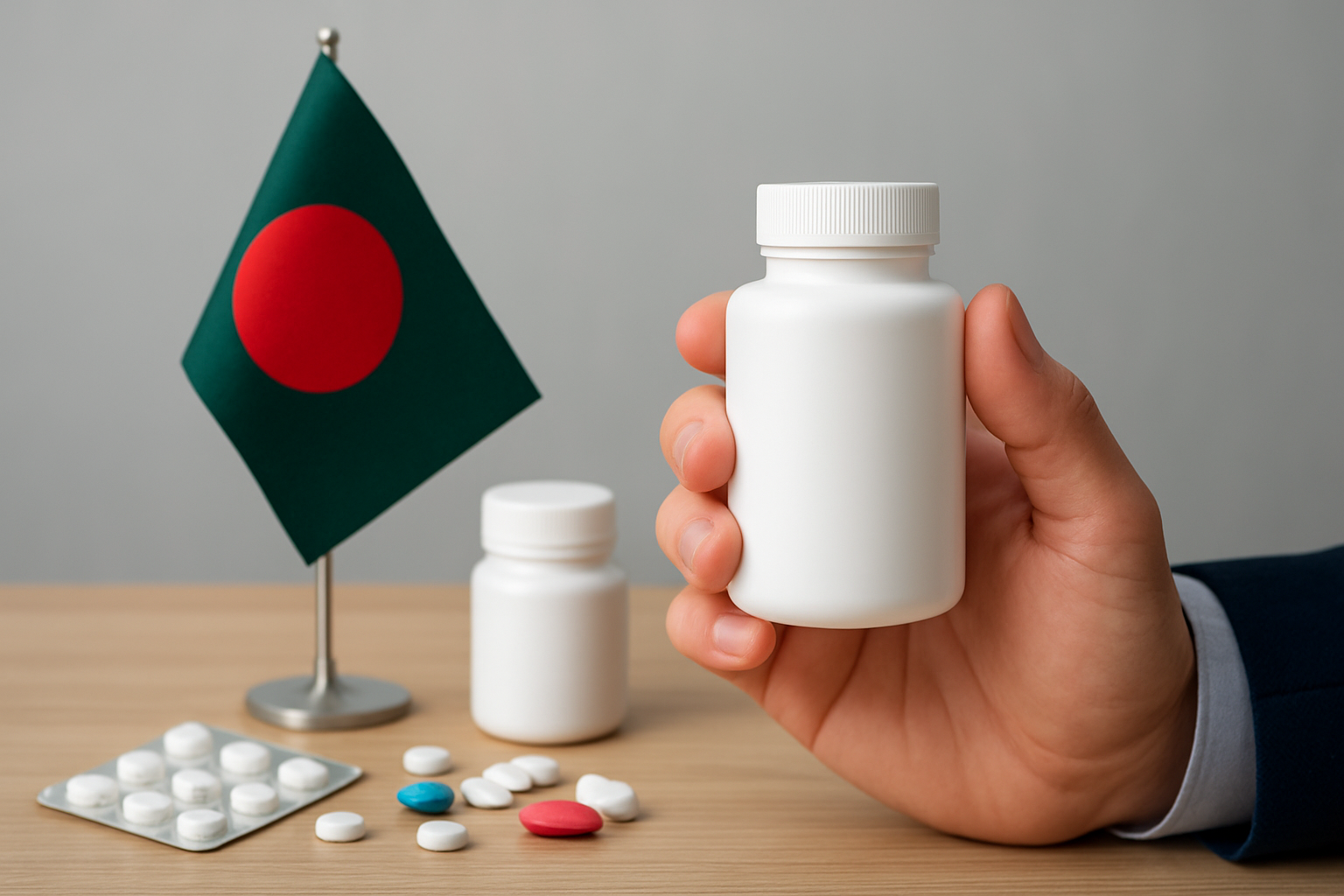
Bangladeshi pharmaceutical products reach more than 160 countries and earned around 213 million US dollars in FY2024-25 — more than double the FY2018 figure. Getting a product into any one of those markets requires clearing two separate regulatory systems: Bangladesh’s, on the way out, and the importing country’s, on the way in.
This guide covers both, plus the changes arriving with LDC graduation.
Part One: The Bangladesh Side
The governing law
Pharmaceutical export from Bangladesh is regulated under the Drugs and Cosmetics Act 2023, which repealed the Drugs Act 1940 and the Drugs (Control) Ordinance 1982. The Act explicitly covers manufacture, import, export, sale, storage, distribution and quality of drugs and cosmetics.
The Directorate General of Drug Administration, under the Health Services Division of the Ministry of Health and Family Welfare, is the sole licensing and regulatory agency.
Prerequisites before any export conversation
A valid manufacturing licence for the site producing the product.
Product registration in Bangladesh. In most cases, the DGDA registers a product for the domestic market first, with the Medicine Regulatory Committee’s acknowledgment or permission. Export-only products follow their own route but still require DGDA authorisation.
Demonstrated GMP compliance. The Act requires manufacturers to follow WHO Good Manufacturing Practice guidelines for quality control, production, distribution, supply and storage. The licensing authority may inspect manufacturing premises, with inspection costs borne by the manufacturer at government-set rates.
Approved raw material imports. Semi-finished drugs and materials required for manufacture cannot be imported without prior approval of the licensing authority.
The core export documents
Certificate of Pharmaceutical Product (CoPP). Issued under the WHO Certification Scheme on the Quality of Pharmaceutical Products Moving in International Commerce. It confirms the product is registered, states whether it is marketed in the exporting country, identifies the manufacturing site, and attests to GMP compliance. This is the single most important document in pharmaceutical export, and most importing regulators require it.
GMP Certificate. Site- and often dosage-form-specific. A certificate covering a tablet facility does not cover a sterile line. Importing authorities check the scope carefully.
Free Sale Certificate. Confirms the product is freely sold in Bangladesh without restriction. Some markets accept this in place of, or alongside, a CoPP.
Manufacturing licence copy. The site’s licence, current and valid.
Product specification and Certificate of Analysis. The registered specification plus batch-specific test results.
Export No Objection Certificate, where the destination or product category requires it.
Legalisation
Many importing countries will not accept Bangladeshi regulatory documents at face value. Depending on the destination, documents may require notarisation, attestation by the Ministry of Foreign Affairs, and legalisation by the destination country’s embassy or consulate. Countries party to the Hague Apostille Convention may accept an apostille instead.
This step is routinely underestimated. It can take weeks and it is a common cause of delayed shipments, particularly for first-time exporters.
Commercial and customs documentation
Alongside regulatory paperwork: commercial invoice, packing list, bill of lading or airway bill, certificate of origin, insurance certificate, and export declaration through the customs system. Exporters register with the Export Promotion Bureau and require an Export Registration Certificate.
Part Two: The Importing Country’s Side
Bangladesh’s approval gets your product out. It does not get it in. Every destination has its own regulator and its own registration process.
Tier 1: Highly regulated markets
United States, European Union, United Kingdom, Australia, Canada, Japan.
Requirements: Full dossier in Common Technical Document format, on-site inspection by the foreign regulator, bioequivalence studies for generics, data integrity scrutiny, and in the US an Abbreviated New Drug Application with Drug Master File support.
Timeline: Typically two to five years from decision to first sale.
Cost: Substantial — facility upgrades, consultancy, study costs, filing fees.
Several Bangladeshi firms hold approvals in these markets from the US FDA, the UK MHRA, and EU GMP status. Reaching this tier changes a company’s standing permanently, but it is not an incremental step from domestic supply.
Tier 2: Semi-regulated markets
Much of Asia, the Middle East, Africa, Latin America.
Requirements: Product registration dossier, CoPP, GMP certificate, samples for testing, sometimes stability data generated under the destination’s climatic zone conditions, a local agent or authorised representative, and product-specific registration fees.
Timeline: Commonly six months to two years.
This tier is where the bulk of Bangladeshi pharmaceutical export volume sits, and where realistic growth is available for manufacturers not yet ready for Tier 1.
Tier 3: Emerging markets
Lighter registration requirements, faster entry, but increasingly tightening as regulators across Africa and Asia strengthen. Building on Tier 3 relationships without preparing for Tier 2 requirements is a short-term strategy.
Practical points that trip up exporters
Stability zone requirements. Many destinations sit in Zone IVb — hot and humid. Stability data generated under milder conditions will be rejected. Plan studies for the destination, not for convenience.
Local agent requirements. Most markets require registration to be held by, or through, a locally established entity. Choosing that partner badly is one of the most expensive errors in export, because registrations are difficult to move.
Labelling and language. Local language requirements, specific warning statements, prescribed formats, sometimes country-specific pack sizes.
Registration validity and renewal. Registrations expire. Renewal timelines vary and missing one means starting over in some jurisdictions.
Variation control. Change the manufacturing site, supplier of the active ingredient, or formulation, and you must notify or re-file in every market where the product is registered. Manufacturers who make changes without tracking their registration footprint create serious compliance exposure.
Part Three: What LDC Graduation Changes
Bangladesh is scheduled to graduate from least developed country status on 24 November 2026. Two distinct effects follow.
Loss of the TRIPS pharmaceutical waiver
The WTO’s LDC pharmaceutical waiver runs to the end of 2033, but only for countries that remain LDCs. Graduation, not the calendar date, is what ends it.
After graduation, Bangladesh must provide product and process patent protection for pharmaceuticals. Roughly one-fifth of the domestic pipeline is estimated to be patented rather than generic. For export, this means patented molecules cannot simply be manufactured and shipped; they require patent clearance, licensing, or use of compulsory licensing provisions.
Bangladesh has amended its patent law toward TRIPS compatibility. The government has formally requested a three-year deferment of graduation from the UN Committee for Development Policy, targeting 2029. A separate route exists at the WTO: seeking a post-graduation transition extension, citing the public health extension granted to the Maldives.
Loss of trade preferences
Duty-free, quota-free access under schemes such as the EU’s Everything But Arms will lapse, though the EU has granted a transition window extending EBA benefits to 2029. Post-graduation tariff exposure across export sectors has been estimated in the range of 8 to 15 percent, with material effects on total national export earnings.
For pharmaceutical exporters specifically, this means landed cost in some markets rises, and price competitiveness against Indian and Chinese suppliers narrows.
What exporters should be doing now
Map your patent exposure. Identify which of your export products involve molecules still under patent in Bangladesh or in destination markets. This is a product-by-product exercise, and it is best done before graduation rather than after.
Diversify destination markets. Concentration in markets where preference loss bites hardest is an avoidable risk.
Invest in the documentation that survives. GMP compliance depth, data integrity, validated processes and complete batch records are what open Tier 1 and Tier 2 markets. They are also what preference erosion cannot take away.
Prepare for tighter regulatory scrutiny. DGDA modernisation, work toward WHO Maturity Level 3 classification, and the registration backlog all mean planning further ahead than previously necessary.
Consider contract manufacturing and partnership routes. Contract manufacturing for foreign principals is one of the strategies most consistently recommended for the post-graduation period, since it monetises capacity without carrying patent exposure on the molecule.
Frequently Asked Questions
What is a CoPP and who issues it in Bangladesh?
A Certificate of Pharmaceutical Product, issued by the Directorate General of Drug Administration under the WHO certification scheme. It confirms registration status, marketing status and GMP compliance of the manufacturing site.
Do I need to register a product in Bangladesh before exporting it?
In most cases yes. DGDA authorisation is required, and importing regulators typically want evidence that the product is registered and marketed in the country of origin.
How long does it take to enter a new export market?
Roughly six months to two years for semi-regulated markets, and two to five years for highly regulated markets such as the US or EU.
Will Bangladeshi pharmaceutical exports face tariffs after LDC graduation?
Yes, in markets where duty-free access was based on LDC status, though transition arrangements exist in some cases, including an EU extension to 2029.
Can a manufacturer export a patented molecule after graduation?
Not without patent clearance, a licensing arrangement, or use of compulsory licensing provisions where applicable. Off-patent generics are unaffected.
Does a GMP certificate cover my whole factory?
No. GMP certification is site-specific and usually dosage-form specific. Check the scope before submitting it to a foreign regulator.
Closing
Exporting pharmaceuticals from Bangladesh in 2026 means satisfying the DGDA, satisfying the destination regulator, and preparing for a patent and tariff environment that changes with graduation. The manufacturers who handle this well are the ones treating documentation depth as an asset rather than an obligation.
PROMIXCO Pharmaceutical Limited is a member of the Bangladesh Association of Pharmaceutical Industries and manufactures medicines, toiletries, cosmetics and food and beverage products from its own production unit in Dhaka.
For export enquiries, private label or OEM arrangements, contact info@promixcopl.com.
This article is general information, not legal or regulatory advice. Confirm current requirements with the DGDA and the relevant importing authority.
