




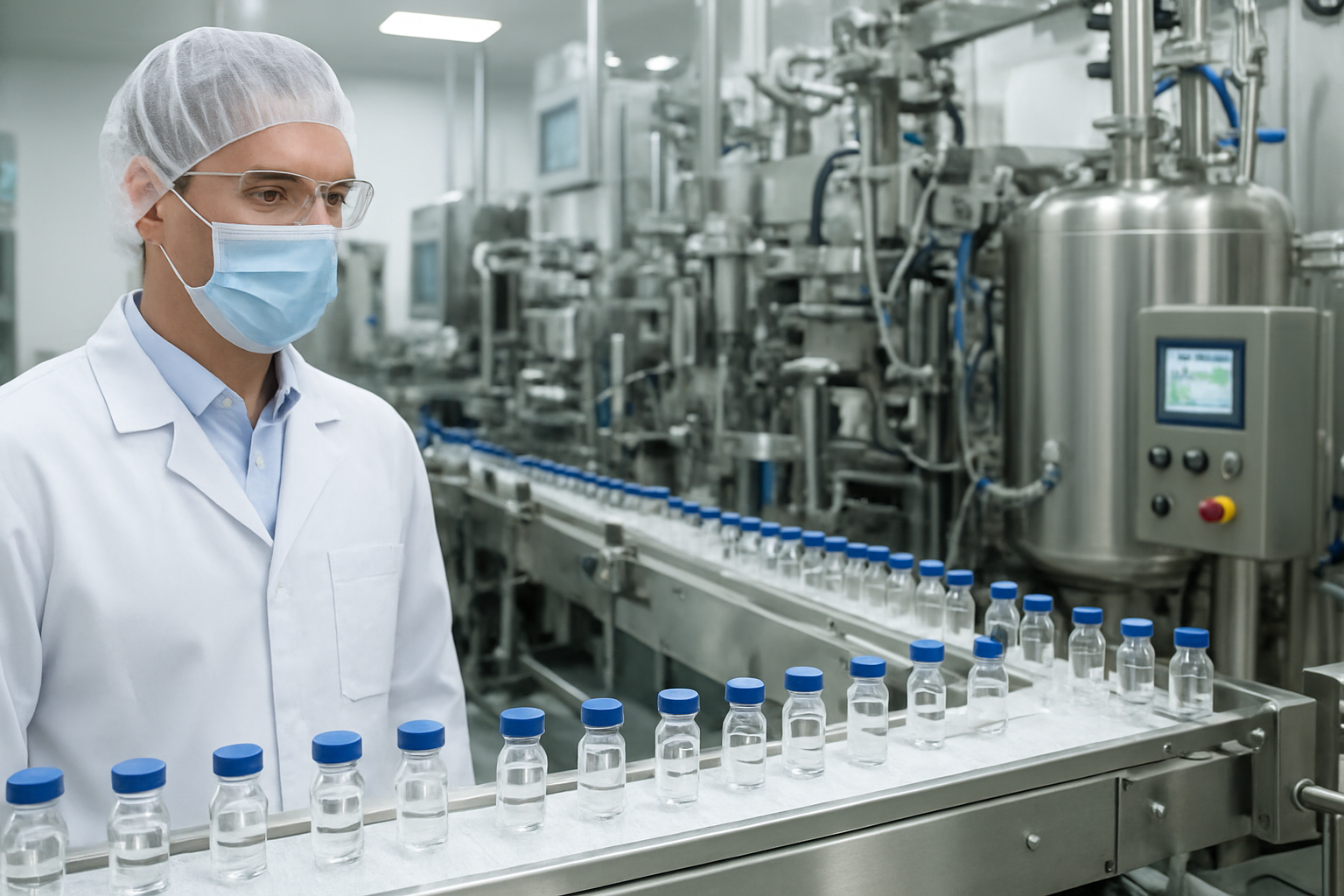
A tablet is a small, dull-looking object. Producing one that contains exactly the right amount of drug, dissolves at the right rate, survives two years in a humid climate, and behaves identically to the 499,999 tablets made alongside it, is one of the more demanding manufacturing problems in industry.
Here is what actually happens between an idea and a strip on a pharmacy shelf.
Stage 1: Formulation Development
Nothing starts on the production floor. It starts with a question about need: is there a therapeutic gap, an unmet dosage form requirement, a product that patients are struggling to take, a strength that isn’t available locally?
Once the need is defined, formulation scientists have to solve a set of competing problems:
Solubility. Many active ingredients dissolve poorly. If the drug does not dissolve, it does not absorb, and the tablet is decoration.
Stability. The active ingredient must survive contact with excipients, moisture, light and heat for the whole shelf life. Some ingredient combinations degrade each other.
Manufacturability. A blend that works in a laboratory beaker may not flow through production equipment. Powder flow, compressibility and stickiness all determine whether a formula can be made at scale.
Patient acceptability. Tablet size, taste of syrups, ease of swallowing. A correct formulation that patients will not take fails.
Development runs through small laboratory batches, then pilot scale, then trial production batches. Each step tends to reveal problems the previous scale hid. Stability studies begin here, with samples held in controlled temperature and humidity chambers and tested at intervals to establish shelf life.
Stage 2: Sourcing and Material Qualification
Bangladesh imports 80 to 90 percent of its active pharmaceutical ingredients, mostly from India and China. This makes material control the highest-leverage step in the entire process.
Suppliers are qualified before first use — documentation review, sample testing, and audits for critical materials. Once a supplier is approved, every consignment is still treated as unproven.
Material arrives and goes to quarantine, physically separated from released stock. It is sampled according to a defined plan. The laboratory performs identity testing and assay, plus other tests appropriate to the material. Only after passing does it move to approved status and become available for production. Failed material is rejected and segregated.
The temptation to skip this — to accept a supplier’s certificate of analysis and release the material straight to production — is the origin of a large share of pharmaceutical quality disasters worldwide.
Packaging materials go through their own qualification. Blister foil quality determines moisture protection, which in Bangladesh’s climate directly affects whether a product survives its stated shelf life.
Stage 3: Dispensing
Production begins with weighing. This happens in a dedicated dispensing area under controlled airflow, because powder released here can contaminate other products.
Every material is weighed against the batch manufacturing record. Two people are involved: one weighs, one verifies. Balances are calibrated and checked at defined intervals. Each weight is recorded with the material’s lot number, so the finished batch can later be traced back to the exact raw material consignments that went into it.
An error here propagates through everything downstream and cannot be corrected later.
Stage 4: Granulation and Blending
Raw powders rarely compress well on their own. Granulation converts fine powder into larger, free-flowing granules.
In wet granulation, powders are mixed with a binding liquid, agglomerated in a high-shear mixer, then dried — usually in a fluid bed dryer — to a target moisture content. Moisture is measured, not assumed, because residual moisture affects both compression behaviour and long-term stability.
In dry granulation, powder is compacted mechanically and milled to the target particle size, avoiding liquid entirely. Used where the active ingredient is moisture-sensitive.
Direct compression skips granulation where the formulation permits, blending powders and compressing them straight away. Fewer steps, but only feasible for materials with suitable flow properties.
After granulation, the granules are blended with the remaining excipients — lubricants, disintegrants, glidants. Blending time is validated: under-mixed gives uneven drug distribution, over-mixed can over-lubricate and impair dissolution.
Blend uniformity is tested by sampling from multiple points in the blender. This is one of the most important in-process checks in the entire process, because it determines whether every tablet contains the same dose.
Stage 5: Compression
Granules are fed into a tablet press, where punches compress them into tablets at high speed — thousands per minute on modern machines.
In-process checks run continuously throughout compression:
- Weight of individual tablets and of samples, at set intervals
- Hardness, which affects both handling durability and dissolution rate
- Thickness, an indicator of consistent fill
- Friability, measuring resistance to abrasion during handling and transport
- Disintegration time, confirming the tablet breaks down as intended
Results are recorded as they are taken, in the batch record. An out-of-limit result stops the run for investigation, rather than being averaged away.
For capsules, the equivalent stage is encapsulation, with fill weight as the critical parameter. For liquids and syrups, it is mixing, filtration and fill volume control.
Stage 6: Coating
Not every tablet is coated, but many are, for several reasons: masking a bitter taste, protecting a moisture-sensitive core, easing swallowing, providing product identity, or controlling where in the digestive tract the drug is released.
Coating happens in a rotating perforated pan where a coating solution is sprayed onto tumbling tablets while warm air dries it. Spray rate, air temperature, pan speed and inlet humidity all have to be held within validated ranges. Too fast and tablets stick together; too slow and the coat is uneven.
Enteric coatings, which resist stomach acid and dissolve in the intestine, demand tighter control still, since incomplete coating defeats their purpose entirely.
Stage 7: Packing
Packing is where a good batch can still be lost, usually through mix-up rather than through a technical failure.
The controlling procedure is line clearance: before a new product runs, the line is inspected and certified clear of all materials from the previous product — no stray tablets, no leftover foil, no old printed material, no obsolete batch coding. This is documented and signed. It sounds trivial. It is the control that prevents one product’s tablets ending up in another product’s pack.
Blister packing seals tablets between formed film and lidding foil. Seal integrity is checked, commonly by vacuum leak testing. Printing of batch number, manufacturing date and expiry date is verified against the batch record and checked periodically through the run.
Strips go into cartons with leaflets, cartons into shippers. Reconciliation is performed at the end: the number of units produced, packed, sampled, rejected and dispatched must add up. Discrepancies are investigated, not written off.
Stage 8: Quality Release
The batch is complete but cannot be sold yet.
Finished-product samples go to the quality control laboratory for testing against the registered specification: assay, dissolution, uniformity of dosage units, microbial limits where relevant, and appearance.
At the same time, the quality assurance function reviews the entire batch record — every weight, every in-process result, every signature, every deviation and its investigation, the reconciliation, and the packaging records.
Only when both the testing and the record review are satisfactory does the quality unit release the batch. The quality unit is organisationally independent of production and has the authority to reject. Nobody in production or commercial can override that decision. Where that independence does not exist, none of the preceding stages mean very much.
Retained samples from every batch are stored under defined conditions for a period beyond the expiry date. If a complaint or query arises two years later, there is physical product to examine alongside the paperwork.
Stage 9: Distribution and Traceability
Released product goes to the warehouse under controlled storage conditions, then out through distribution to pharmacies, distributors, retail chains, hospitals and institutional buyers.
Distribution records tie each batch to the destinations it reached. This is what makes a targeted recall possible: if a problem is identified, the affected batch can be located and withdrawn without disrupting supply of everything else.
Why the Documentation Is Not Bureaucracy
People new to the industry often see the paperwork as overhead. It is the opposite: the paperwork is the product’s identity.
When a pharmacy calls about a batch, the batch record answers what happened. When a regulator inspects, the records are the evidence that the process was controlled. When an export customer asks for a Certificate of Pharmaceutical Product, the underlying records are what make it defensible. When something genuinely goes wrong, the records are the difference between a precise recall and a blind one.
A process that was performed correctly but not recorded is, from a regulatory and practical standpoint, a process that cannot be shown to have happened.
Frequently Asked Questions
How long does it take to produce one batch of tablets?
Manufacturing typically takes a few days depending on the process, but the full cycle including quality testing and record review before release is usually longer — commonly one to several weeks.
What is the difference between in-process and finished-product testing?
In-process testing checks parameters while manufacturing is happening, so that problems are caught and corrected during production. Finished-product testing confirms the completed batch meets specification before release.
Why do tablets from the same medicine sometimes look different?
Different manufacturers use different excipients, coatings and tooling. Appearance can differ while the active ingredient, strength and specification remain the same.
What is a retained sample?
A sample from each batch kept under controlled storage beyond expiry, so that the actual product can be examined if a question arises later.
Do all manufacturers follow this process?
The stages are broadly standard. What varies significantly is rigour — how thoroughly materials are tested, how honestly deviations are documented, and whether the quality unit genuinely has authority.
Closing
From formulation to shelf, a modern pharmaceutical production line is a chain of controlled steps in which each stage is defined in advance, checked while it happens, and recorded so it can be reconstructed later.
PROMIXCO Pharmaceutical Limited operates its own production unit covering tablets, capsules, syrups and topical preparations, with four controlled stages — formulate, source and test, manufacture, distribute — and full batch traceability from raw material to dispatch.
To arrange a facility visit or discuss private label and OEM production, contact info@promixcopl.com.
