




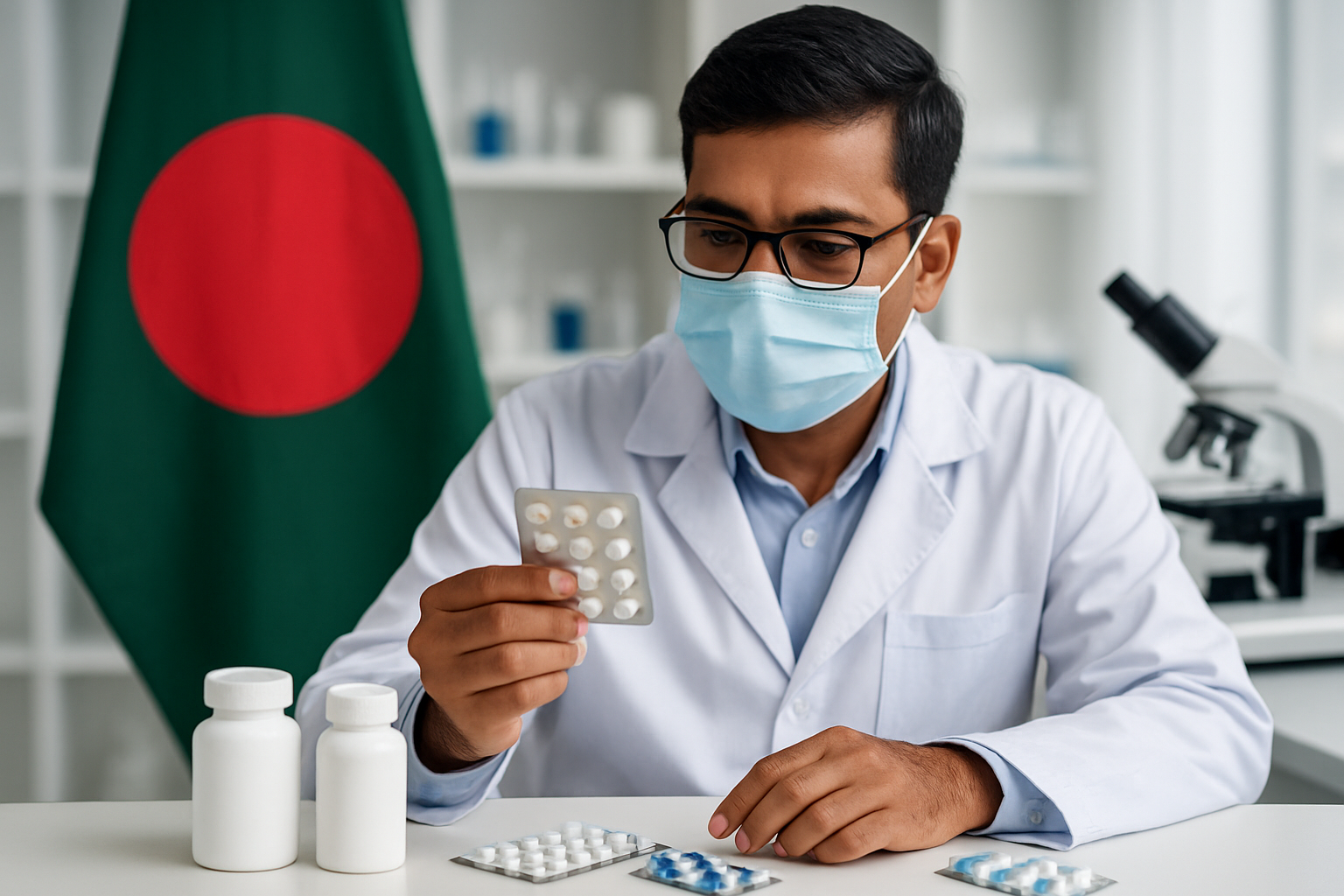
Fifty years ago Bangladesh imported almost all of its medicine. Today it manufactures around 98 percent of what the country consumes and sells to more than 160 export destinations. The domestic market alone is worth over 3.5 billion US dollars, and pharmaceutical export earnings reached roughly 213 million dollars in FY2024-25 — more than double the FY2018 figure.
That is the headline. The more interesting question in 2026 is why buyers in other countries increasingly treat “made in Bangladesh” as a mark of reliability rather than a discount, and what is about to change.
How the Industry Got Here
A policy decision that worked
The turning point was the Drugs (Control) Ordinance of 1982, which restricted non-essential imports and gave local manufacturers a protected space to build capability. Combined with a young, educated workforce and low production costs, the result was a generic industry that grew from almost nothing into the country’s largest white-collar employer.
The TRIPS flexibility
As a least developed country, Bangladesh has been exempt from full compliance with the World Trade Organization’s Agreement on Trade-Related Aspects of Intellectual Property Rights. In practical terms, local firms could manufacture patented molecules without licences or royalties. That freedom let Bangladeshi manufacturers offer a wide therapeutic range at prices that made them competitive across Asia, Africa and Latin America.
Investment in facilities that pass foreign audits
The reputational shift came from certification. Several Bangladeshi firms now hold approvals from the US Food and Drug Administration, the UK Medicines and Healthcare products Regulatory Agency, and hold EU Good Manufacturing Practice status. These are not paperwork exercises. They involve foreign inspectors walking production floors and reading batch records. Passing them repeatedly changes how a country’s output is perceived.
Regulatory infrastructure catching up
The National Drug Control Laboratory achieved WHO prequalification for drug testing in 2020 and holds ISO/IEC 17025:2017 accreditation from both the Bangladesh Accreditation Board and the ANSI National Accreditation Board. Meanwhile the Drugs and Cosmetics Act 2023 replaced the 1940 and 1982 legislation, introduced serious criminal penalties for adulterated products, brought cosmetics and medical devices under DGDA authority, and wrote WHO GMP compliance into statute.
What Bangladesh Actually Exports
The export mix is broader than most people assume. It includes solid dosage forms — tablets and capsules across cardiovascular, antidiabetic, gastrointestinal and anti-infective categories — plus liquids and syrups, topical preparations, injectables from a smaller number of qualified facilities, inhalers, ophthalmics, and a growing biosimilar segment.
Destination markets fall into three tiers with quite different requirements. Highly regulated markets such as the US, EU, UK, Australia and Canada demand site inspection, full dossier submission and often bioequivalence data. Semi-regulated markets across Asia, the Middle East, Africa and Latin America typically require registration supported by a Certificate of Pharmaceutical Product and GMP evidence. Emerging markets have lighter registration burdens but are increasingly tightening.
The 2026 Inflection Point
Bangladesh is scheduled to graduate from least developed country status on 24 November 2026. This is the single most consequential date in the sector’s recent history, and it is worth being precise about what it does.
The WTO’s LDC pharmaceutical waiver runs to the end of 2033 — but only for countries that remain LDCs. Graduation, not the calendar, is what ends it. On graduation, Bangladesh forfeits the waiver and becomes obliged to provide both product and process patent protection for pharmaceuticals.
The exposed portion of production is narrow but valuable. Estimates put roughly one-fifth of the domestic pipeline in patented rather than generic molecules. Those products will need patent clearance, licensing, or the use of compulsory licensing provisions after graduation. Newer high-value categories — oncology drugs, biosimilars, treatments for autoimmune conditions — sit disproportionately in that exposed fifth.
Bangladesh has formally requested a three-year deferment of graduation from the UN Committee for Development Policy, which would move the date to 2029. There is also a separate route: seeking a post-graduation TRIPS transition extension at the WTO, citing the public health precedent granted to the Maldives. Whichever path is taken, the underlying work is the same, and it is already underway.
What the Industry Is Building in Response
Domestic API capacity
Bangladesh currently imports 80 to 90 percent of its active pharmaceutical ingredients, mostly from India and China. That dependency is the sector’s most obvious structural weakness: it exposes manufacturers to price volatility and supply shocks, and it limits the value added locally. The API Industrial Park at Gazaria in Munshiganj, established on 200 acres by BSCIC, is the government’s answer. Progress has been slower than planned, with utility supply a persistent constraint, but several major manufacturers have set up facilities there and commissioning has begun.
Regulatory maturity
The DGDA is working toward WHO Maturity Level 3 classification, which signifies a regulatory authority that is stable, well-managed and internationally recognised. This matters commercially, not just institutionally: without ML-3, Bangladeshi vaccine exports remain effectively blocked from global procurement channels, and registration in some markets is harder than it needs to be.
R&D and formulation capability
The strategic shift being asked of the industry is from copying off-patent formulations toward genuine development work: novel drug delivery, complex generics, biosimilars, and contract development for foreign partners. That is a slower and more capital-intensive route, but it is the one that survives patent obligations.
Depth in quality systems
The competitive question is shifting from price to documentation. Buyers in serious markets want data integrity, validated processes, complete batch records and audit-ready facilities. Manufacturers who built those systems for their own reasons are finding they now have a commercial moat.
What Buyers Should Ask a Bangladeshi Supplier in 2026
If you are sourcing from Bangladesh, price comparison alone is a poor screen. Ask instead:
Which regulatory approvals cover this specific site and dosage form? Approvals are site- and line-specific. A company-level claim is not an answer.
Do you own the production unit or contract it out? Own-manufacture means one accountable party for formulation, sourcing, in-process control and release.
What is your API sourcing and qualification process? Given import dependency, supplier qualification and incoming material testing are the real control points.
How is this molecule’s patent status handled post-graduation? For anything recently developed, the supplier should have a clear answer rather than a hopeful one.
Can you produce a batch record on request? The speed and completeness of the answer tells you more than any certificate.
What is your stability data under zone IVb conditions? Hot and humid storage conditions are the realistic test for products going to South Asia, Southeast Asia or much of Africa.
The Honest Risks
It would be misleading to present only the growth story. Loss of duty-free access in some markets will raise landed costs. Tariff exposure after graduation is real across all export sectors. API dependency remains unresolved. DGDA capacity is stretched, with a backlog of drug registration applications that has itself become a strategic problem. And pharmaceutical exports still represent well under two percent of total national export earnings, which limits political attention relative to the garment sector.
None of these is fatal. All of them are reasons for buyers to look at individual manufacturers rather than at country-level averages.
Frequently Asked Questions
How many countries does Bangladesh export medicine to?
Bangladeshi pharmaceutical products reach more than 160 destinations, with FY2024-25 export earnings of roughly 213 million US dollars.
Will Bangladeshi medicine become more expensive after LDC graduation?
Prices for patented and newly developed molecules are likely to rise, since royalty and licensing costs enter the cost base. Established generics, which make up the bulk of production, are far less affected.
Is Bangladeshi medicine quality comparable to Indian medicine?
Both countries have a wide quality range. The meaningful comparison is between individual manufacturers and their certifications, inspection history and quality systems — not between national labels.
What certificates do I need to import Bangladeshi medicine?
Typically a Certificate of Pharmaceutical Product, a GMP certificate for the manufacturing site, free sale certification, and a registration dossier meeting the importing country’s format. Requirements vary by destination.
Can Bangladeshi manufacturers do private label or contract manufacturing?
Yes, and it is a growing segment. The important checks are the same as for branded supply: site certification, quality system depth and demonstrated batch traceability.
Where This Leaves Us
Bangladesh’s position as a pharmaceutical exporter was built on cost advantage and legal flexibility. It is being rebuilt, under time pressure, on quality systems, regulatory credibility and domestic input capacity. The manufacturers making that transition deliberately will emerge with a stronger proposition than the one they had.
PROMIXCO Pharmaceutical Limited manufactures medicines, toiletries, cosmetics and food and beverage products from our own production unit in Bangladesh, and is a member of the Bangladesh Association of Pharmaceutical Industries. To discuss supply, private label or OEM arrangements, reach us at info@promixcopl.com.
