




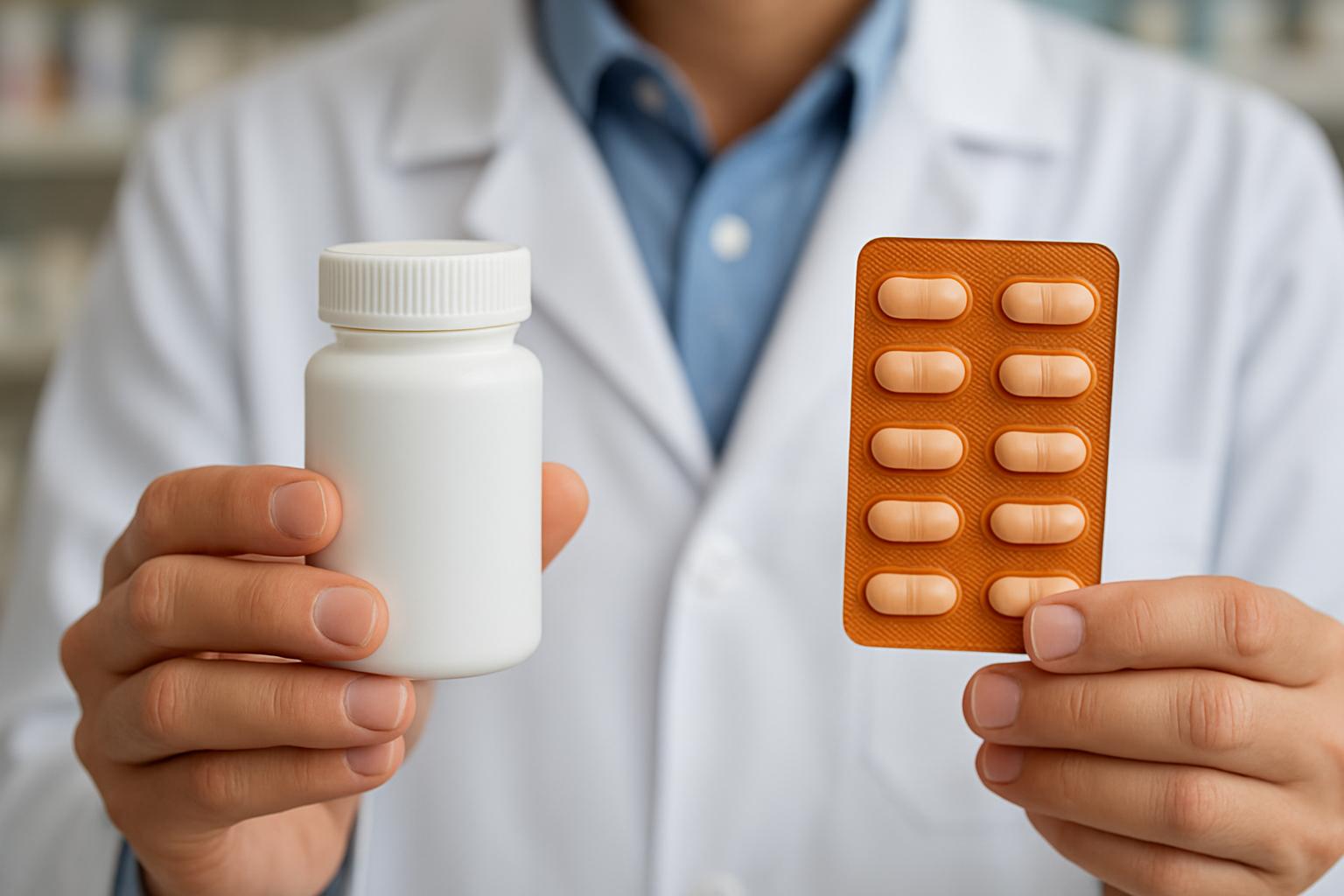
A medicine that exists but cannot be afforded is, for the person who needs it, the same as a medicine that does not exist. This is the central problem of pharmaceutical access, and Bangladesh has solved a large part of it in a way few comparable countries have.
Roughly 98 percent of the medicine consumed in Bangladesh is made in Bangladesh. The domestic market is worth over 3.5 billion US dollars. Compare that with countries of similar income that import most of their pharmaceuticals and pay import prices, foreign exchange costs and importer margins on every dose.
Understanding how this happened — and what threatens it — matters, because the same forces determine what a strip of medicine will cost next year.
Why Local Manufacturing Lowers Prices
Import costs disappear
An imported medicine carries the manufacturer’s price, international freight, insurance, customs duty, importer margin, distributor margin and retailer margin. Local manufacture removes several of these layers entirely.
Foreign exchange exposure shrinks
When a country imports finished medicine, every taka depreciation raises the price of treatment. Local manufacture confines that exposure to imported raw materials, which is a fraction of the finished product’s value. This is not theoretical protection — currency movement is one of the largest single drivers of medicine price change in import-dependent markets.
Competition works
Bangladesh has well over a hundred pharmaceutical companies producing around 8,000 generic products. For any common molecule, multiple manufacturers compete. That competition, not price control, is the main mechanism keeping common medicine costs low. A patient can often find versions of the same molecule at a threefold price spread and choose accordingly.
The TRIPS flexibility
As a least developed country, Bangladesh has been exempt from full compliance with the WTO’s intellectual property agreement for pharmaceuticals. Local firms could produce patented molecules without licences or royalties. For expensive therapeutic areas — oncology, biologics, treatments for autoimmune conditions — this has meant the difference between a treatment costing a fortune and costing something a middle-income family can attempt.
Scale
High-volume production spreads fixed costs across large batches. A facility running continuously produces a lower unit cost than one running intermittently, which is one reason domestic demand of this size supports low prices.
Where the Gap Still Is
It would be dishonest to present the picture as solved. Several access problems persist.
Out-of-pocket spending. A large share of health expenditure in Bangladesh is paid directly by households at the point of care. Where insurance coverage is thin, the price of a medicine is not partially absorbed — it is felt in full, immediately, by the family.
Chronic disease costs compound. A hypertension or diabetes patient does not buy one strip. They buy every month, indefinitely. A 6 taka daily cost is 2,190 taka a year, per medicine, and most such patients take more than one.
Newer molecules remain expensive. The affordability success is concentrated in established generics. Recently developed treatments, biologics and biosimilars remain out of reach for many, even at local production prices.
Rural distribution. Availability is not uniform. Distribution depth, storage conditions and stock reliability vary considerably outside urban centres. A cheap medicine that is not in stock locally is not accessible.
Diagnostic and consultation costs. Medicine is only part of the bill. Reaching the point of having a prescription costs money too.
What Local Manufacturers Actually Do About It
Manufacturers are not charities, and it would be misleading to pretend otherwise. But there are several ways commercial behaviour and access align.
Producing across the essential medicines list. The therapeutic categories with the highest disease burden — anti-infectives, antidiabetics, cardiovascular, gastrointestinal, respiratory — are also the highest-volume commercial opportunities. Competing on those means competing on price.
Investing in efficiency rather than only in price. Yield improvement, reduced batch rejection, better raw material sourcing and process optimisation lower unit cost without lowering quality. This is the sustainable route. Cost reduction achieved by cutting testing or accepting weaker materials is not cost reduction; it is deferred harm.
Building distribution depth. Reaching district and upazila-level pharmacies reliably converts a low price into actual access. Manufacturers with broad nationwide distribution networks make more difference to rural availability than pricing policy alone.
Range breadth across pack sizes. Smaller pack sizes let a patient buy what they can afford this week rather than skipping treatment entirely. It is a minor commercial decision with a real access effect.
Producing consumer health and hygiene products. Access to health is broader than access to prescription medicine. Affordable soap, oral care, safe drinking water and hygienically produced food products prevent illness that would otherwise require treatment. Manufacturers operating across pharmaceuticals, toiletries and food and beverage lines under one quality system are working on both sides of that equation.
The 2026 Question: What LDC Graduation Does to Prices
Bangladesh is scheduled to graduate from LDC status on 24 November 2026. The WTO’s pharmaceutical waiver runs to the end of 2033 — but only for countries that remain LDCs. Graduation forfeits it.
After graduation, Bangladesh must provide both product and process patent protection for pharmaceuticals. Around one-fifth of the domestic pipeline is estimated to be patented rather than generic. Those molecules will need patent clearance, licensing agreements, or the use of compulsory licensing provisions.
The practical effects, stated plainly:
Established generics are largely unaffected. Molecules whose patents expired long ago — which is most of what most people take — continue as before.
Newer patented molecules get more expensive. Royalty and licensing costs enter the cost base. For some specialised drugs, price increases could be severe.
Some products may not be launched at all. Where licensing cannot be negotiated affordably, the product simply does not enter the market.
Production costs rise generally. Patent payment obligations affect the industry’s overall cost structure, which can feed through to domestic prices beyond the patented segment.
Bangladesh has formally requested a three-year deferment of graduation to 2029 from the UN Committee for Development Policy. Separately, a post-graduation TRIPS transition extension can be sought at the WTO, with the public health extension granted to the Maldives cited as precedent. Neither outcome is guaranteed, and both are best understood as time to prepare rather than as solutions.
The Preparations That Matter for Affordability
Domestic API production. With 80 to 90 percent of active ingredients imported, raw material cost and supply security are the largest lever on finished medicine price. The API Industrial Park at Gazaria in Munshiganj exists to change this. Progress has been slower than hoped, with gas supply a real constraint, but several manufacturers have commissioned facilities there.
Legal preparedness. Bangladesh has amended its patent law toward TRIPS compatibility. How strictly patentability criteria are applied, and how readily compulsory licensing and parallel importation provisions can be used, will shape post-graduation affordability considerably.
Regulatory capacity. Faster, more predictable registration lets competing versions reach the market sooner after patent expiry, which is when prices fall. A registration backlog is, in effect, an affordability problem.
Bioequivalence and R&D capability. Moving from copying formulations to developing them is what allows local manufacturers to compete on newer molecules rather than only older ones.
Frequently Asked Questions
Why is medicine cheaper in Bangladesh than in many countries?
Local manufacture of the great majority of consumption, intense competition among many domestic producers, low production costs, and the TRIPS flexibilities available to least developed countries.
Will medicine prices rise after LDC graduation?
Prices for patented and newly developed molecules are likely to rise. Established generics, which account for most consumption, are far less exposed.
Is cheaper medicine lower quality?
Not necessarily. All registered products must meet the same specifications and GMP requirements. Price differences between manufacturers of the same molecule reflect promotion, brand equity and quality investment in varying proportions.
What is the essential medicines list?
A nationally defined list of medicines considered to meet priority healthcare needs. Expansion of the National Essential Medicines List is one of the developments shaping Bangladeshi pharmaceutical regulation in 2026.
How can I reduce my family’s medicine costs safely?
Ask your pharmacist about alternative manufacturers of the same molecule, ask your doctor whether generic prescribing is appropriate, buy only from licensed pharmacies, and never split or stop a prescribed course to save money without discussing it with your prescriber.
Closing
Affordable medicine access in Bangladesh was built on domestic manufacturing capacity, competition, and a legal flexibility that is now ending. Holding the gains through that transition depends on domestic raw material capacity, regulatory efficiency, careful use of the legal tools that remain, and manufacturers who reduce cost through efficiency rather than through quality shortcuts.
PROMIXCO Pharmaceutical Limited manufactures medicines, toiletries, cosmetics and food and beverage products in Bangladesh, supplying pharmacies, distributors, retail chains, hospitals and institutional buyers nationwide. For trade terms or supply enquiries: info@promixcopl.com.
